
Holidaze

o
Imagine, for a moment, the late Roman Empire’s public relations department, a small, exhausted group of pagans hunched over a calendar, staring into the abyss of December. Winter, at this point, was not a mood but a full-blown apocalypse. The sun vanished by mid-afternoon, infrastructure was collapsing, and the general population smelled faintly of damp wool and despair. Something had to be done. Preferably something festive.
The solution arrived in the third century, when Emperor Aurelian designated December 25th as Dies Natalis Solis Invicti, the Birthday of the Unconquered Sun. It was inspired governance. The days were, finally, getting longer. People could drink. Fires could be lit. And, for a brief moment, no one asked inconvenient questions about the empire’s slow-motion implosion. A holiday, it turns out, is an excellent distraction from decay.
A century later, the Christian Church surveyed this already well-attended party and made a bold, historically consequential decision. Pope Julius noticed that the Bible was strangely quiet on the precise date of Jesus’s birth. Shepherds, after all, do not typically linger in open fields during a Judean winter unless they have a strong interest in frostbite. But rather than let geography interfere, the Church opted for a different strategy, one that would later become familiar to Silicon Valley, the hostile merger.
The Unconquered Sun was replaced with the Son of God. Same date, same festive momentum, just a new executive at the top. It was a marketing masterstroke. You keep the trees and the candles, the feasting and the gift-giving, but you change the theology. Paganism did not disappear so much as it was quietly rebranded.
Even so, challenges remained. Selling Crucifixion Day as a retail-friendly spectacle was never going to be easy. Medieval torture scenes do not move sweaters. You cannot, no matter how clever the copy, sell scented candles from Calvary. So the Church pivoted. Out went the jagged wood and bloody public execution. In came hay, livestock, and a silent, photogenic infant. The story shifted from a man enduring state-sanctioned brutality to an adorable baby doing absolutely nothing. History’s greatest prequel was born. Christ: Manger Edition. Minimal dialogue. Strong visual appeal. No complaints about heretics.
This was the version that stuck.
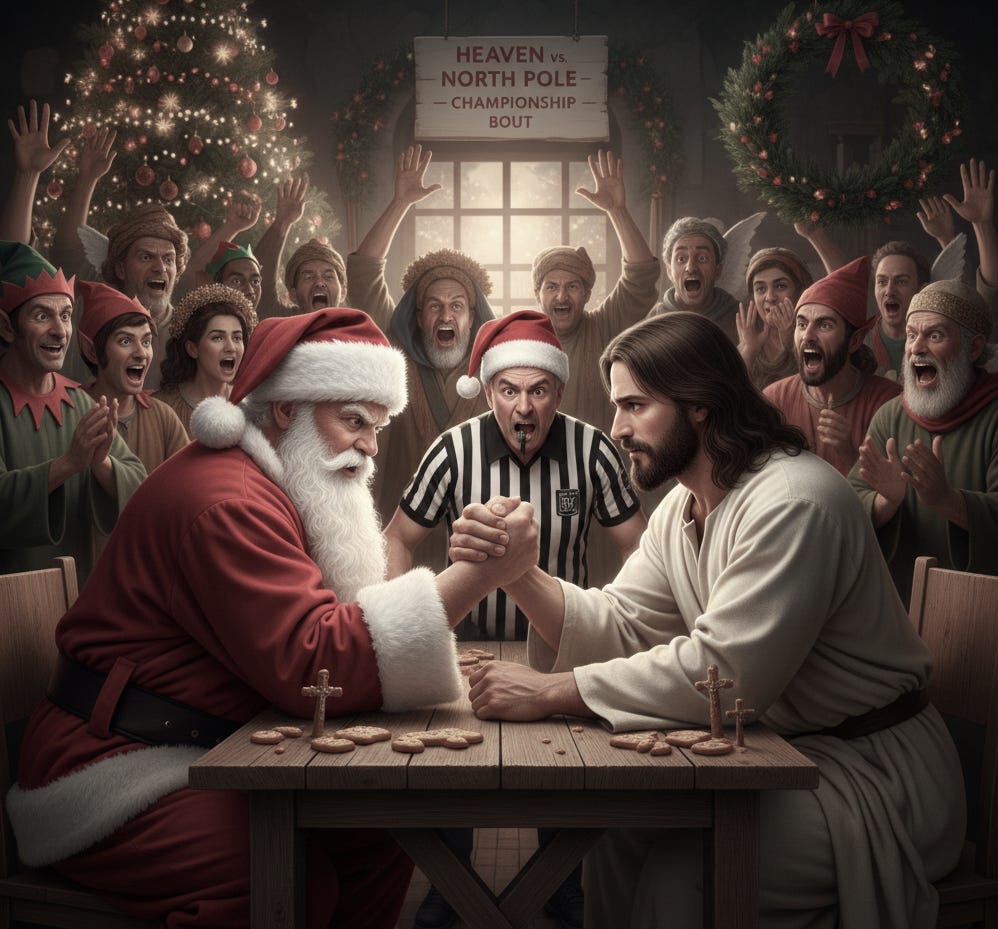
As a child, I accepted all of it, along with Santa Claus, a generously proportioned man who violated the laws of physics annually by sliding down sooty chimneys with a sack of consumer goods and a reckless disregard for carbon monoxide. This, somehow, felt plausible. It somehow still does. A fat guy breaking into our homes once a year to leave presents makes more narrative sense than a man who was briefly murdered, only to reverse the decision because his father was also himself.
If we are ranking implausibilities, Santa has the advantage of clarity, strong branding, and a consistent employment record. He asks very little. Be decent. Go to sleep. Don’t ask too many questions. Christian theology, by contrast, asks us to accept a series of metaphysical loopholes that would get a tax attorney disbarred. God sends his son, who is also God, to be executed by the state, in order to forgive humans for sins that God, who is omnipotent, could have forgiven without the execution. The story’s emotional power is undeniable, but its internal logic feels like it was workshopped under time pressure, possibly by the same Roman committee that approved Saturnalia.
Fast-forward to the present, where every December the phrase “Merry Christmas” is wheeled out like a political hostage. At some point, Donald Trump announced that he had personally “rescued” Christmas, a curious claim considering Christmas had survived emperors, plagues, reformations, and the invention of the leaf blower without his assistance. What he appeared to mean was that he had liberated “Merry Christmas” from the existential threat posed by “Happy Holidays,” a greeting no one was being forced to use and which had never demonstrated hostile intent.
This rescue, in typical fashion, involved trying to execute happiness itself. Trump has long demonstrated a talent for removing joy from any container into which it is poured. “Happy Holidays” was not an attack on Christianity. It was an acknowledgment of reality, a concession that December contains more than one occasion and more than one kind of believer. Trump’s objection was never theological. It was tonal. “Happy” is not a word he trusts. Happiness implies contentment without dominance, pleasure without grievance. If he could, one suspects he would replace it with something sturdier, something more on brand, like “Mandatory Festivities.”
Commercialism, meanwhile, has not merely joined the holiday. It has eaten it. Black Friday now metastasizes across the calendar like a retail tumor. We celebrate by buying discounted things we cannot afford, for people who already have too much, to commemorate a story we vaguely remember and a chimney that, structurally speaking, does not work.
Then there is eggnog, which stands as perhaps the most honest symbol of the season. A drink so aggressively unappealing that it requires nutmeg, alcohol, and social obligation to survive. Eggnog is thick, beige sludge, and tastes like someone liquefied a colonial diary. If it were genuinely enjoyable, we would drink it year-round. No one waits eleven months to consume a beverage they actually like. Eggnog exists precisely because Christmas demands rituals that make no sense but persist through repetition. It is not consumed because it is good. It is consumed because it is there.
And yet, beneath the Roman maneuvering, the theological gymnastics, the political theater, and the dairy-based offenses, something quieter endures. The part worth keeping. The real holiday spirit lives in the small rituals that remind us we belong to one another. In generosity. In gathering. In singing badly with people we love. In the simple act of giving, which is ultimately a way of saying, you matter enough to receive something.
It is also a season we should all recognize the quieter presences in our lives, the animals who share our homes and offer companionship without commentary or conditions. If the holiday teaches us anything enduring, it may be that warmth matters, ritual matters, and that leaving something special under a tree was, almost certainly, an idea we stole from the dogs.
Choose wisely: One says “forever and forever, Amen! The other one says Hi HO! Hi HO!, it’s off to hell we go!